In recent years, I’ve been deeply engaged in researching my ancestry, especially focused on identifying veterans within my family tree. As a veteran myself, I feel a personal connection to their stories. Whenever I discover a new veteran, I try to dig deeper to uncover their service history and assign them a military tag on their profile.
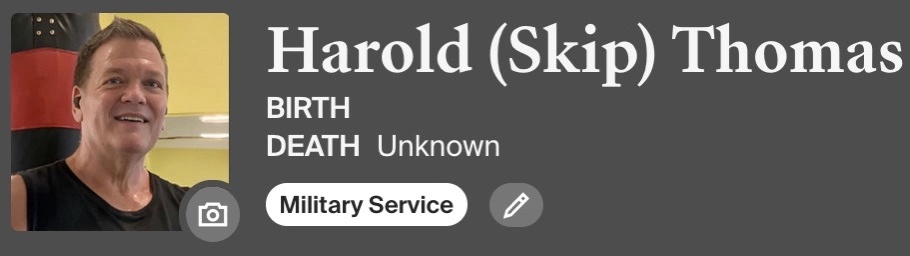
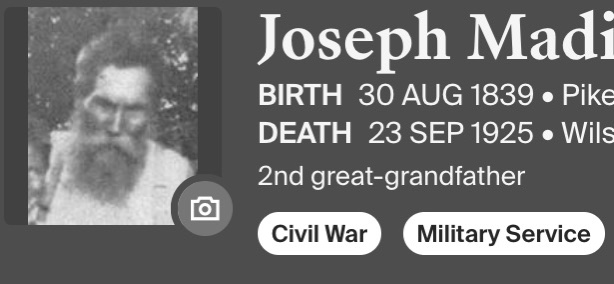
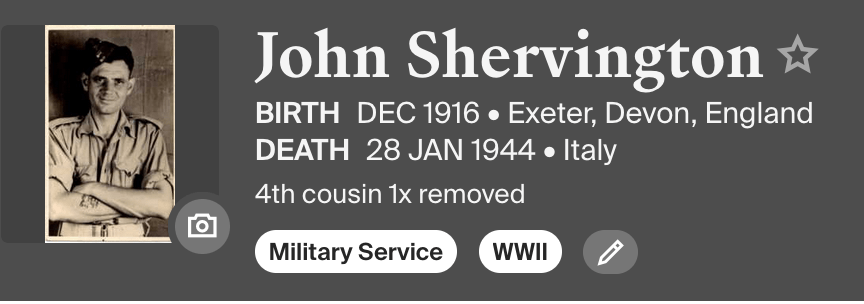
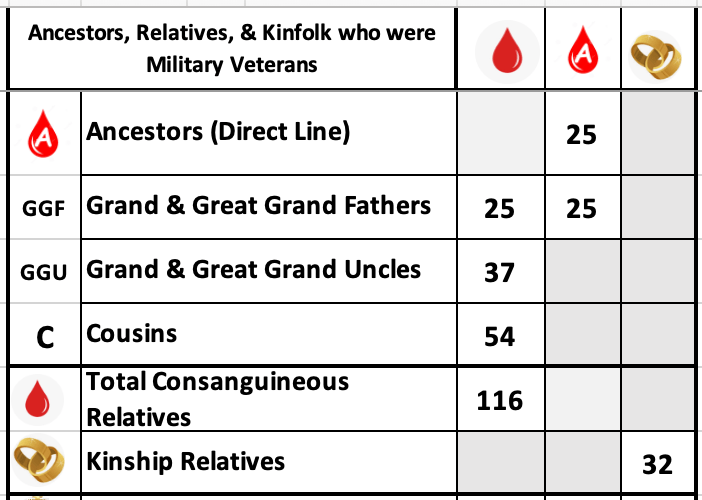
Over the years, I’ve found many veterans in my family tree, and my research recently took an exciting turn. A close DNA match helped solve the mystery of my grandmother’s 1922 adoption, revealing her maternal biological identity and leading to the discovery of even more veterans in my lineage. My research is ongoing, but so far, I’ve identified 25 ancestors, 91 uncles and cousins, and 32 kin who served.
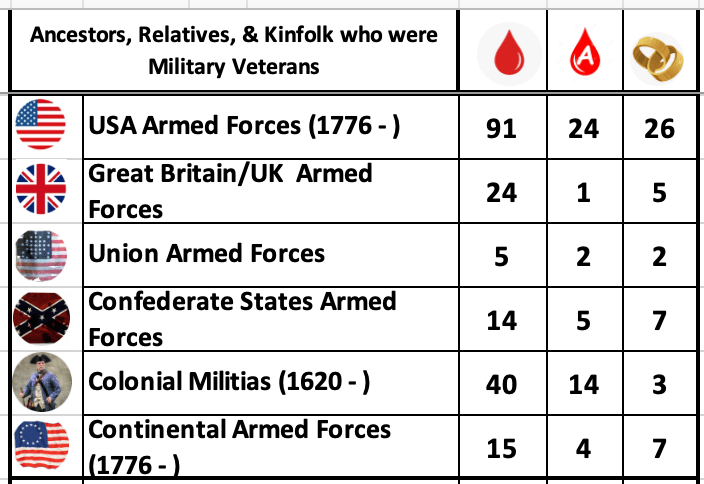
The veterans in my family tree held various allegiances: from the armed forces of Great Britain and pre-revolutionary colonial militias loyal to the Crown to revolutionary and post-revolutionary militias and Union and Confederate forces.
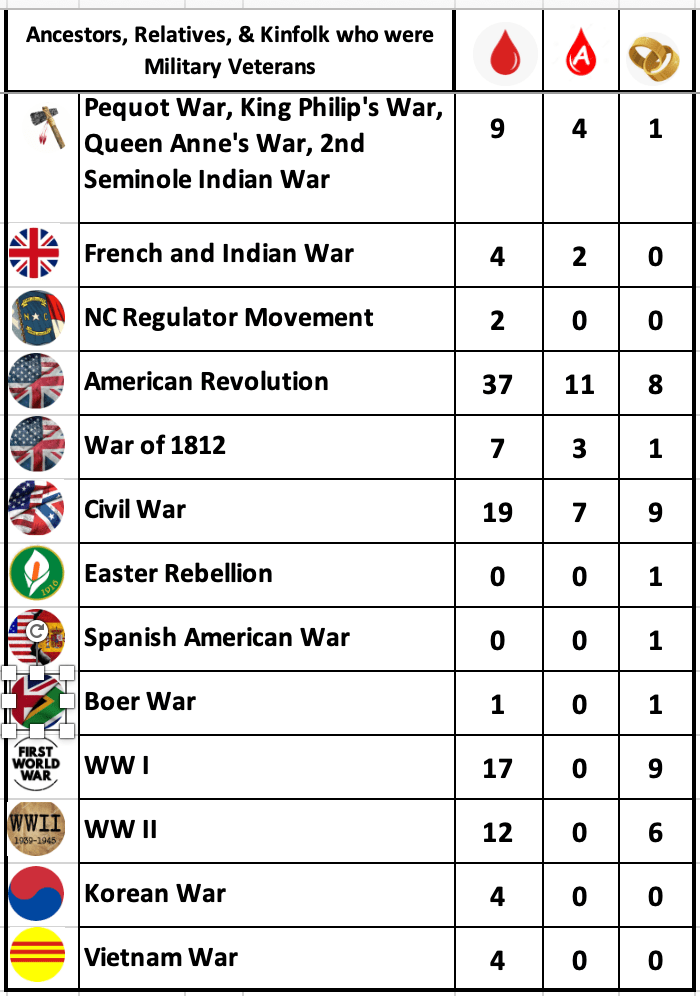
Some served in conflicts, while others did not. Still, many have records detailing their involvement in battles spanning pre-revolutionary conflicts through the Vietnam War across North America, Europe, Africa, the Arabian Peninsula, and India.
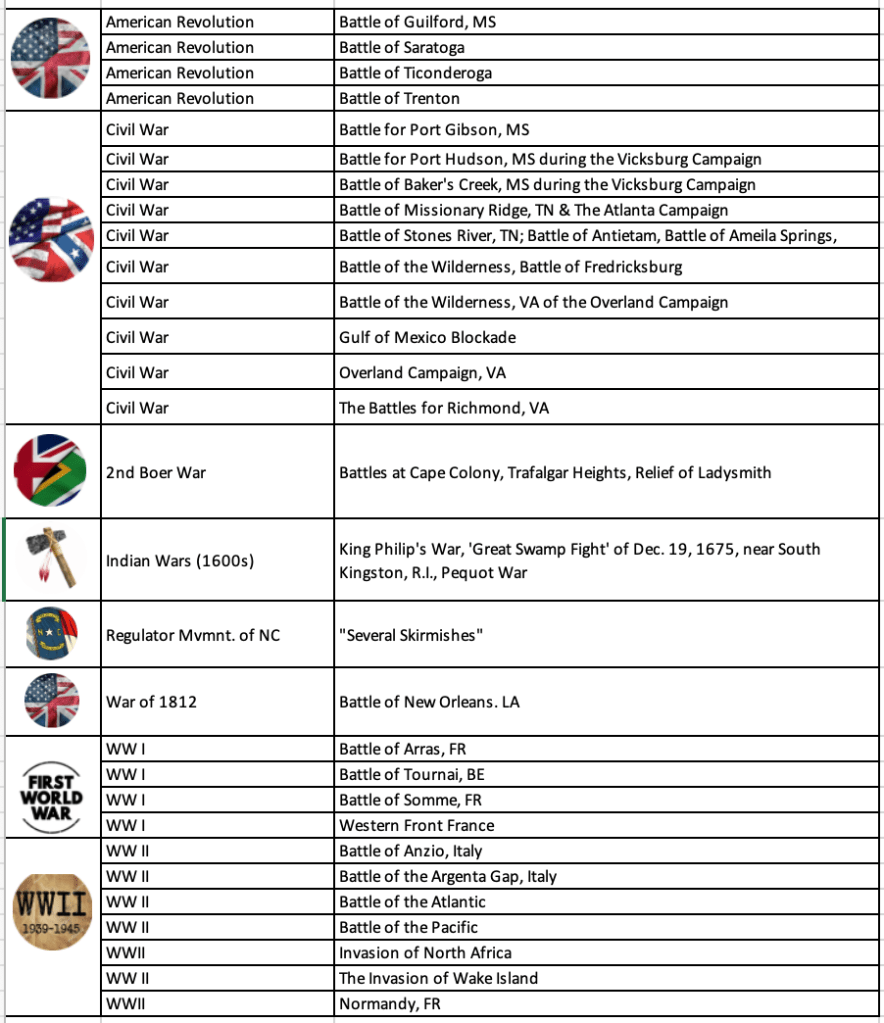
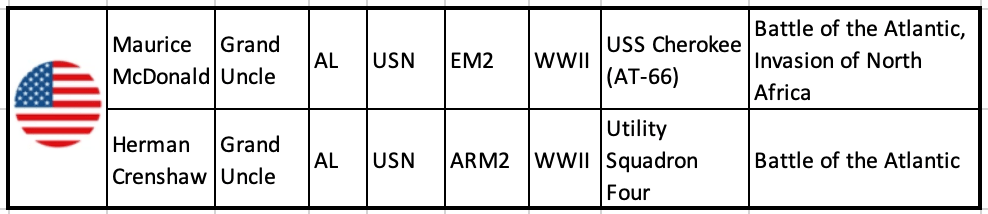
Records from WWII onward are not yet fully available online, but some veterans’ records even indicate which battles they fought in, as shown below.
Sadly, some were wounded, taken prisoner, or died.
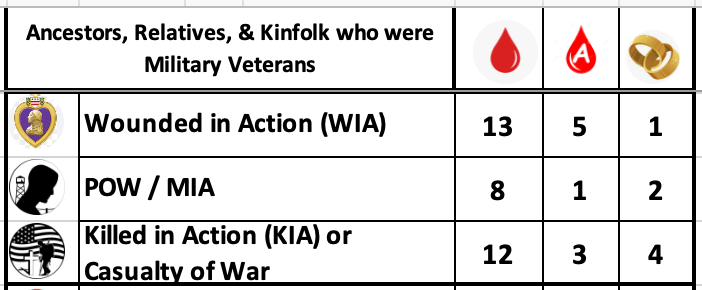
A few notable veterans in my family include:
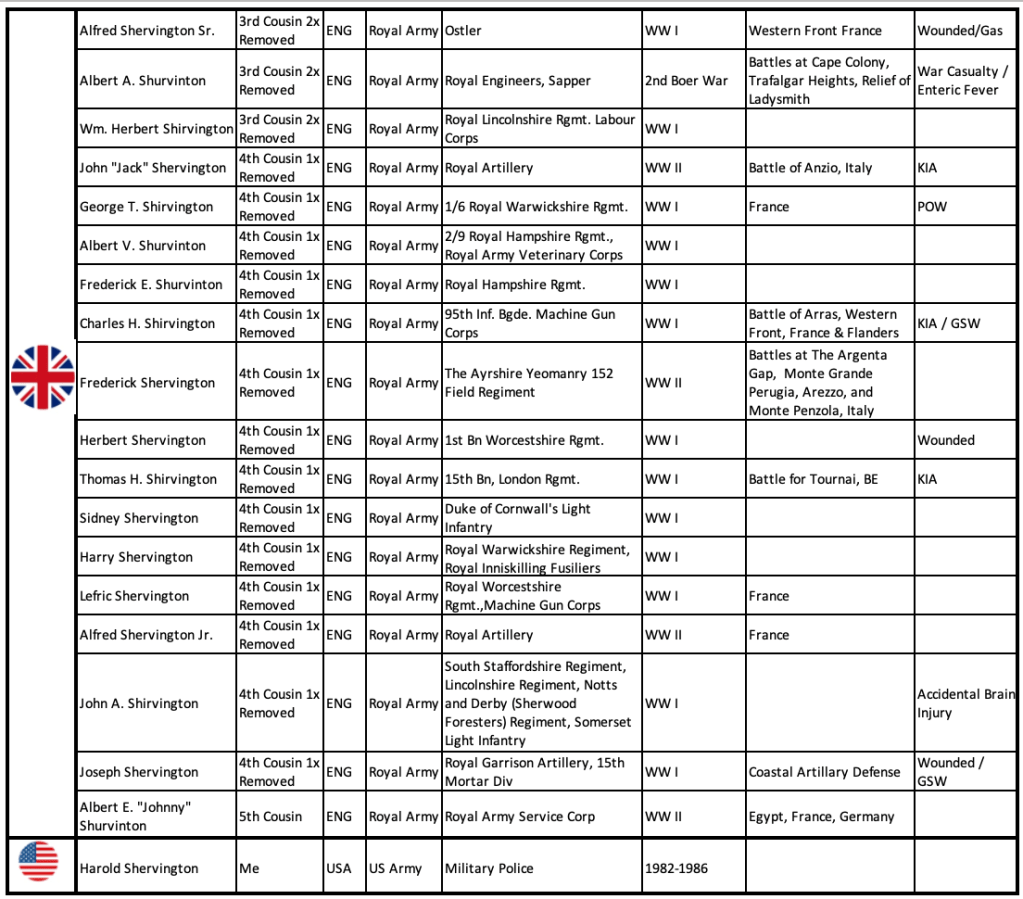
SHERVINGTON Veterans: *Special thanks to my 5th cousin Colin from across the pond for some last minute additions. Colin and I are related through my 4th great-grandfather Job Shervington (b.1758-d.1835).
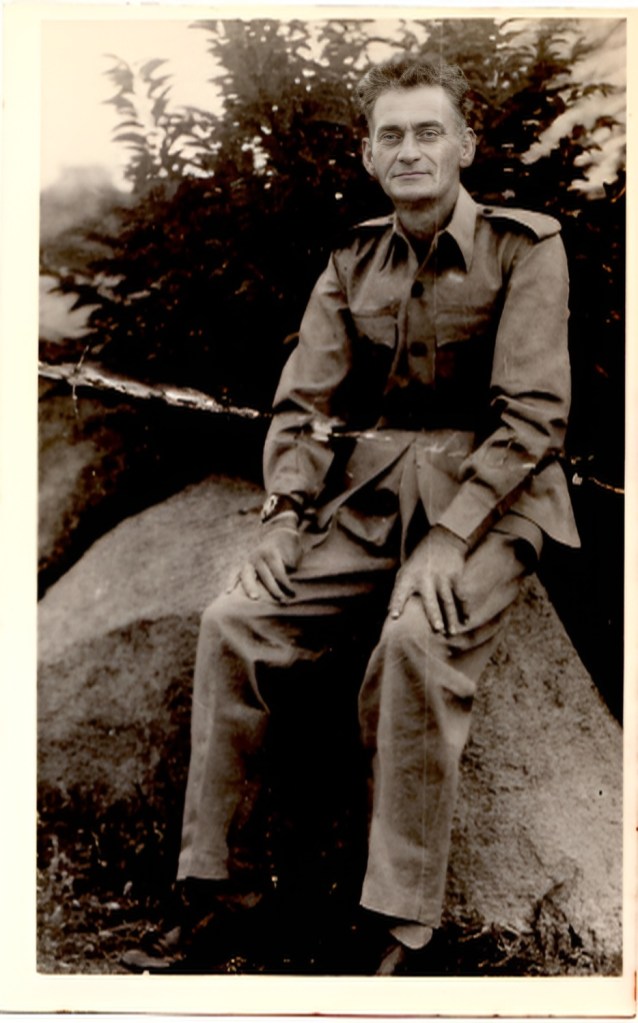
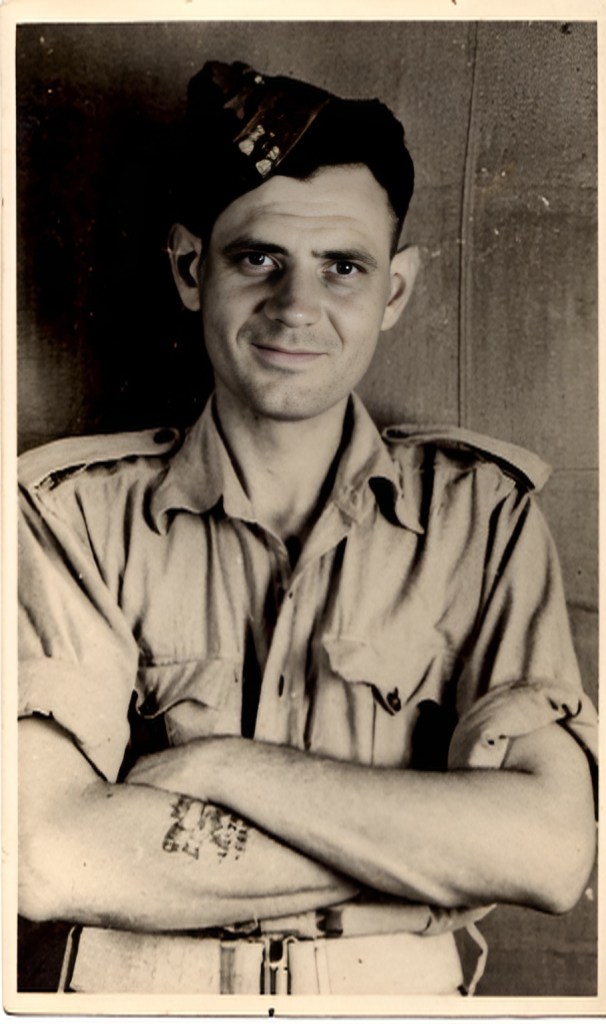
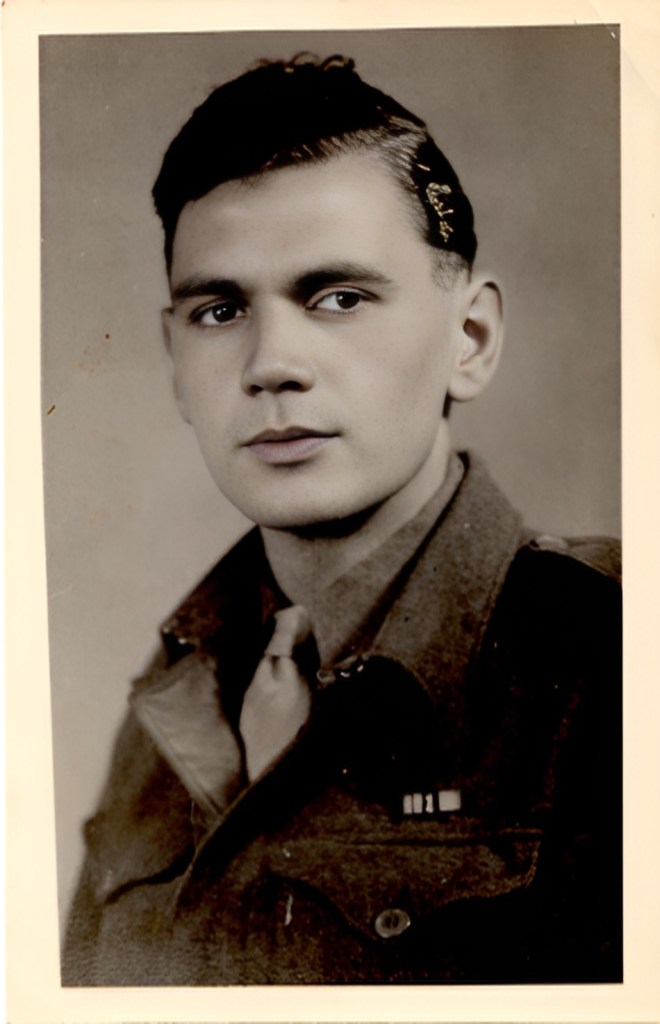
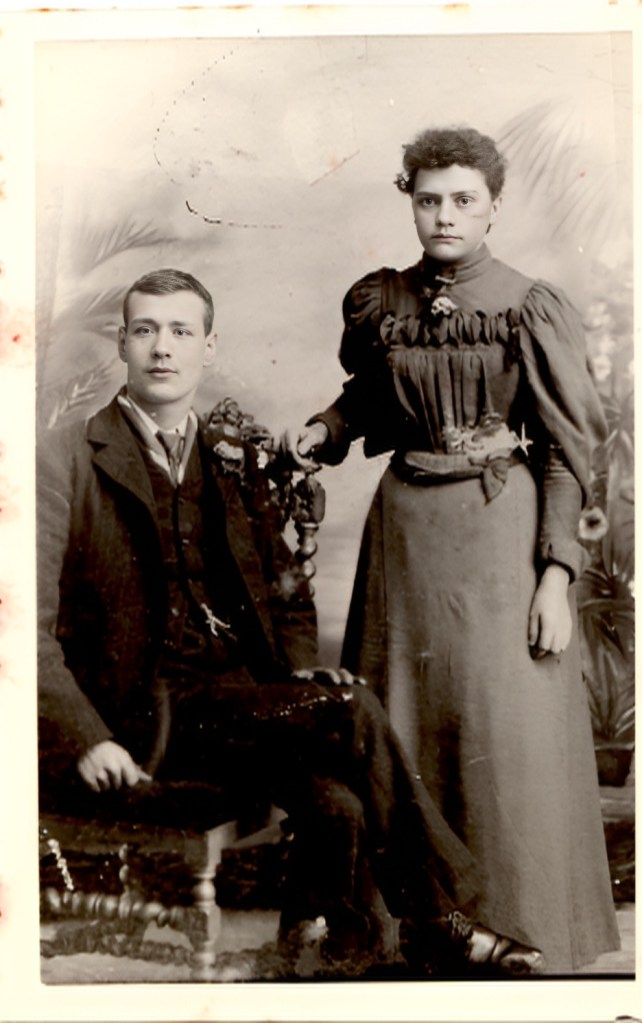
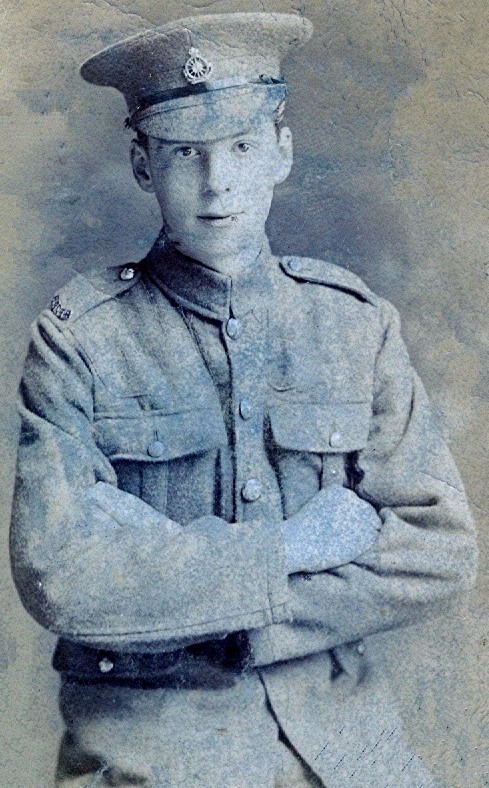
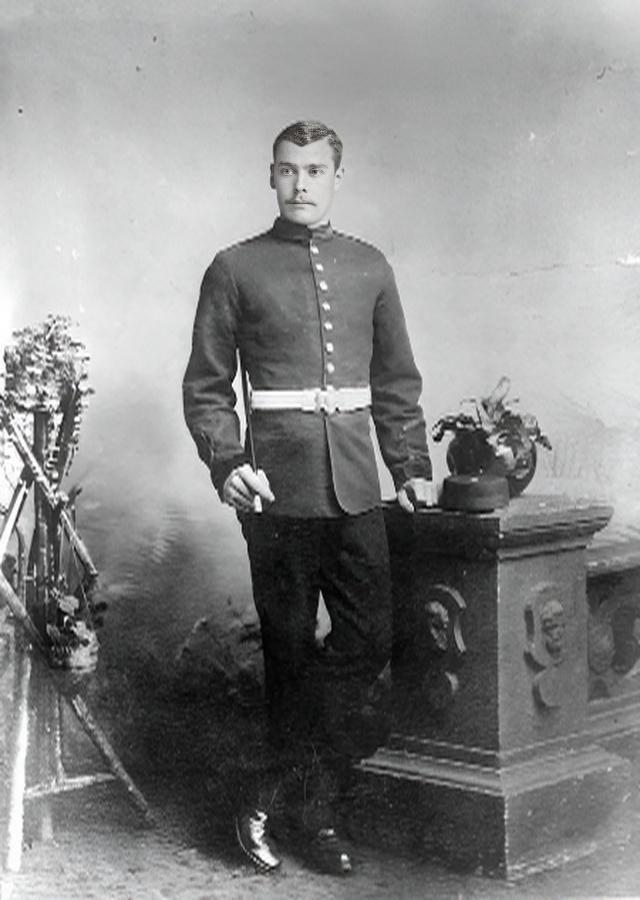
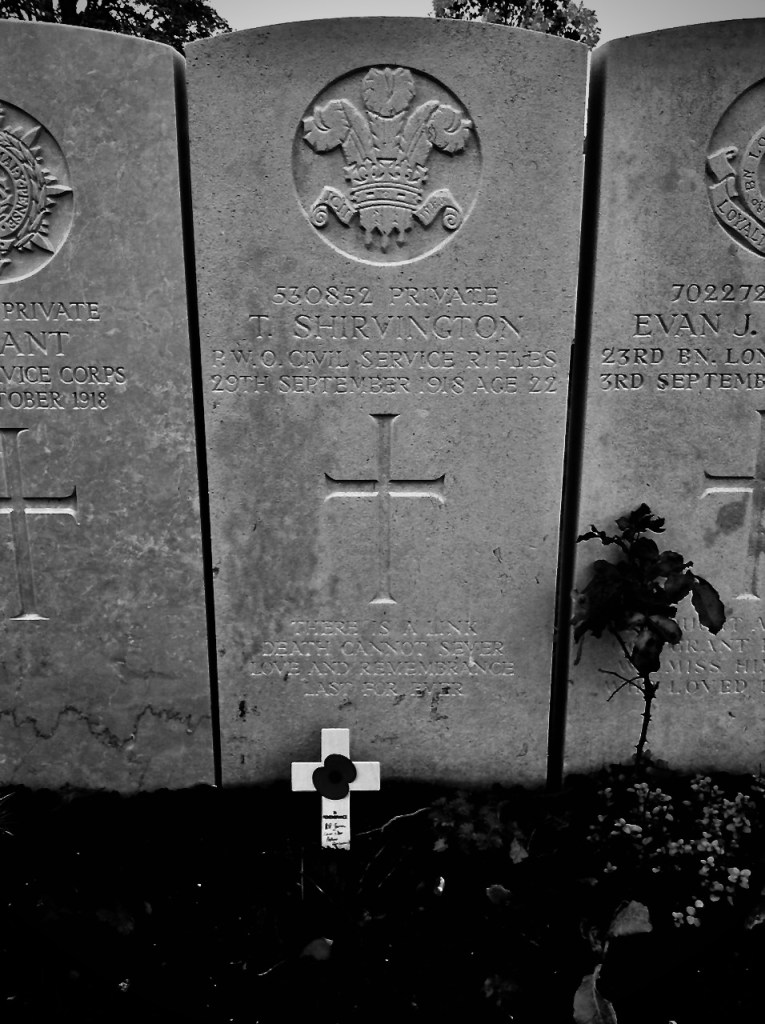
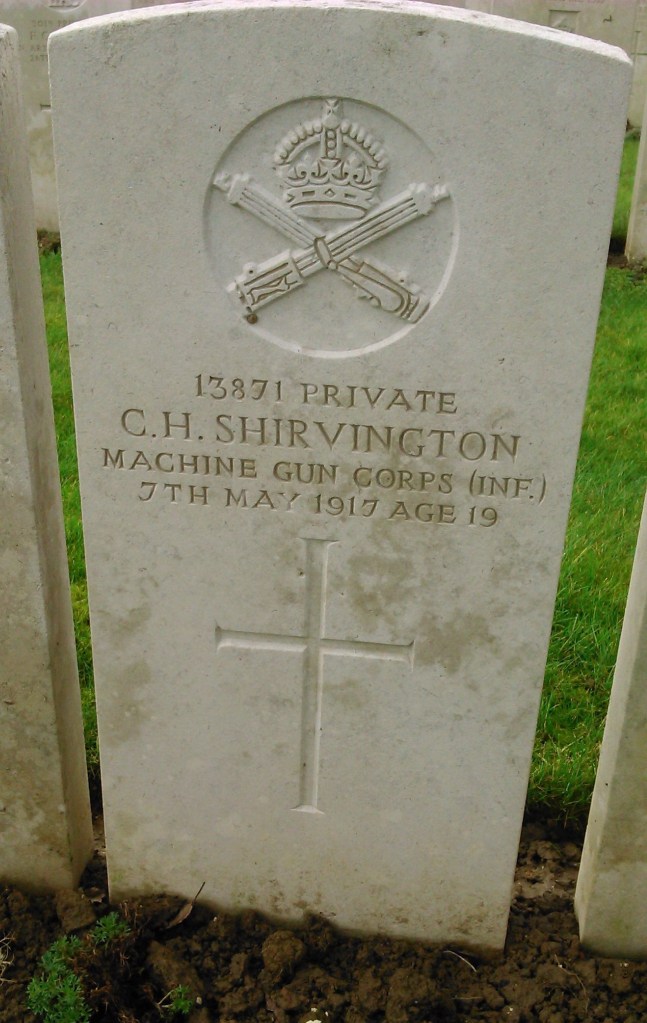
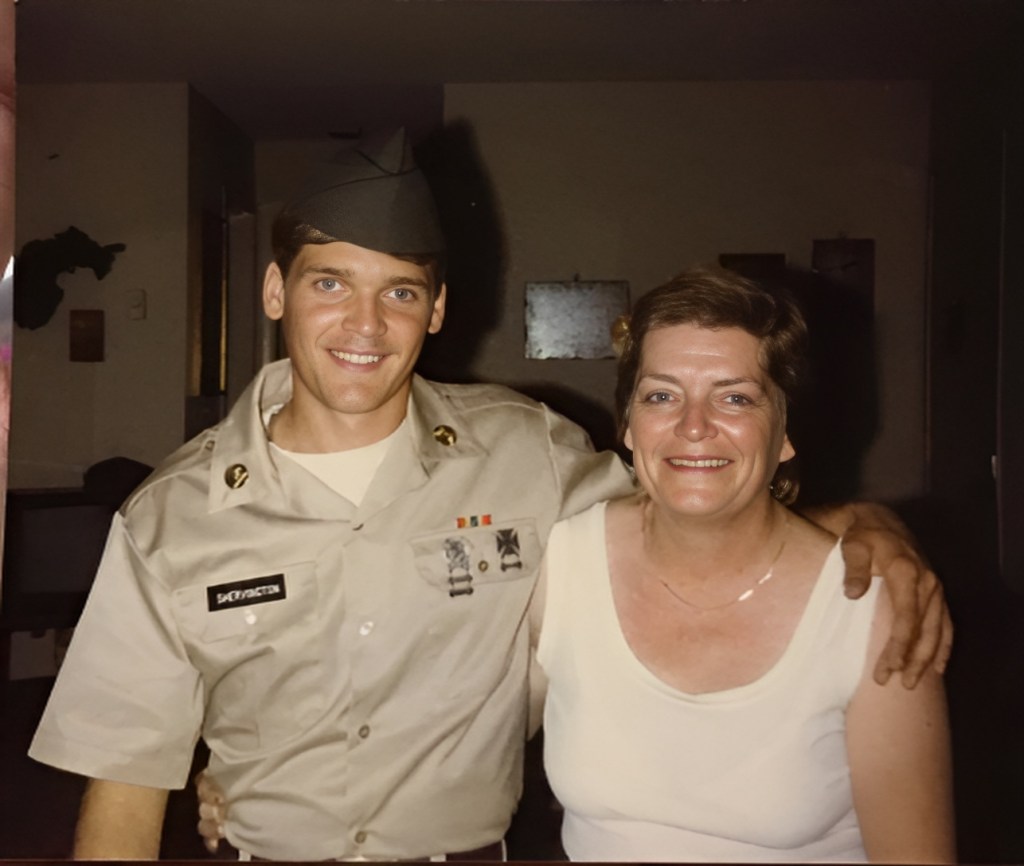
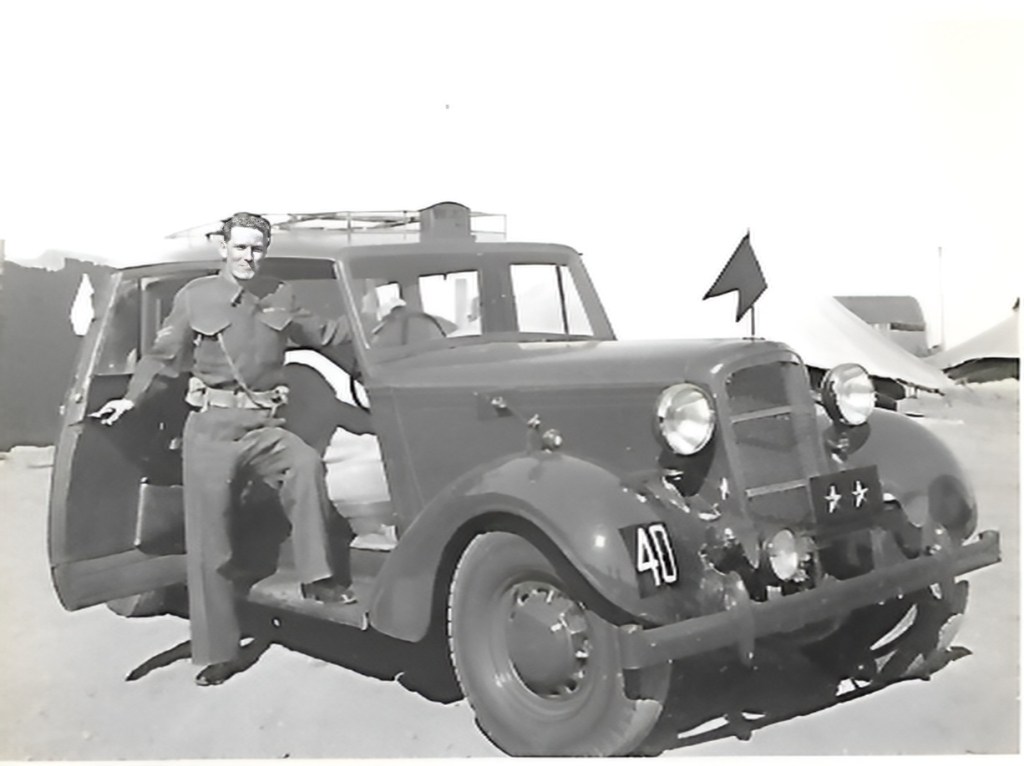
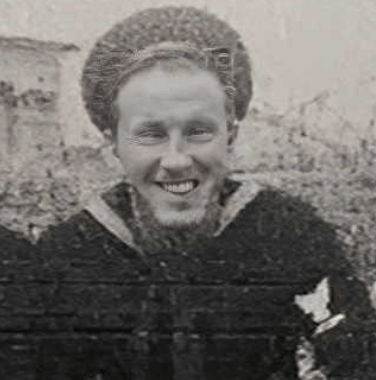
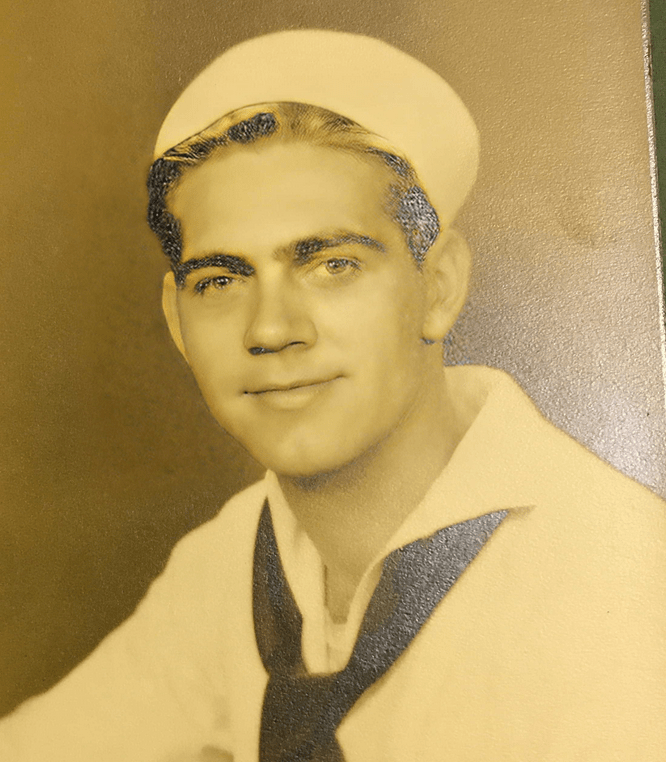
Closest Relatives I Knew Personally: Uncle Mac and Uncle Claude
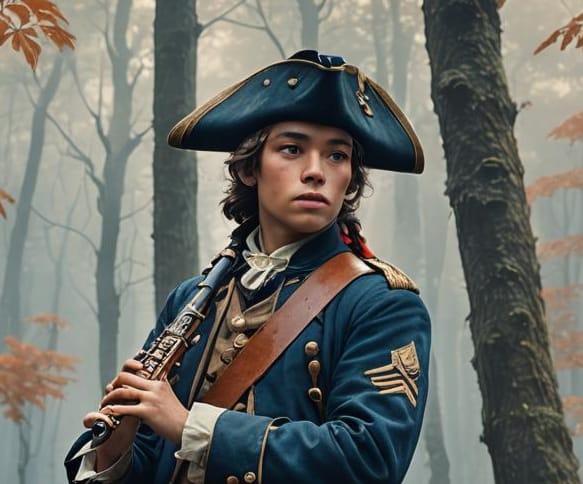
Youngest Veteran and Likely the Lowest Ranking: At just 17, Shubael Bumpus signed up for a three-year term in the Massachusetts colonial militia as a fifer in Colonel Gamaliel Bradford’s Regiment and Colonel Joshua Eddy’s Middleborough Men. He joined reinforcements around Fort Ticonderoga in June 1777 and participated in the Battle of Saratoga that same year.

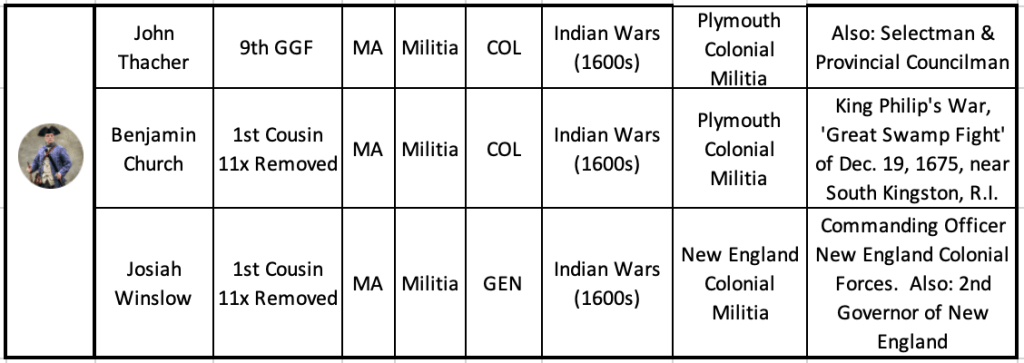
Oldest Historical Veterans: The earliest veterans in my family tree include my 9th great-grandfather, John Thacher (c.1638–1713), and two cousins, Benjamin Church (c.1640–1717) and Josiah Winslow (1628–1680). Likely serving by 1665, John Thacher reached Major by 1694 and later retired as a Colonel. He wrote to the Lieutenant Governor about challenges recruiting volunteers for conflicts with Native American tribes.
They can’t all be heroes… To paraphrase a famous quote,
“One man’s patriot is another man’s insurrectionist.”
I began my research with the intention of identifying veterans in my family tree, honoring those who answered the call to serve, and preserving their memory. I wanted to acknowledge each family member’s military service, whether it was free of injury or came at a great cost—physical wounds, emotional scars, or even death. Keeping their memory alive for future generations feels like the most fitting way to honor them.
But what do you do when you encounter a relative whose actions don’t align with your personal view of who deserves to be celebrated? Do you erase them from your tree or hide their history? And what about those veterans who were part of larger injustices? We can’t truly know our relatives’ personal beliefs or the reasons that led them to serve. Yet one thing remains clear in today’s world: we need those who answer the call. We need warriors. It’s often more about how they are directed than the individuals themselves. So, instead of ignoring those in my family tree who might feel difficult to honor, I decided to include another category—choosing historical truth over revision or ignorance.
The Most Infamous Veteran: Determining the “most infamous” veteran is subjective. This distinction is often blurred further by the painful realities of colonialism, genocide, and other horrific acts of war and injustice committed against both combatants and innocent civilians.
The causes people choose to fight for often bring up complex moral questions. Some may take up arms to defend oppressive institutions like slavery, while others are conscripted into wars with little understanding of why they are risking their lives. In my own family history, for example, I have ancestors who fought to protect slavery or contributed to the subjugation, displacement, and erasure of Indigenous populations. Regardless of the cause, war brings chaos, death, and destruction, and opens the door to the brutalities that come with it.
The farther back in time we look, the more brutal humanity appears to have been. That’s why I believe it’s important not to judge our ancestors solely by today’s standards. They lived in a different era, influenced by unique circumstances and cultures that shaped their beliefs and actions. Recognizing this context doesn’t mean we abandon our modern values. Still, I think certain historical figures—particularly those in power—should be held to a higher standard. As leaders, they may have had access to education and some awareness of evolving societal norms. They likely recognized these shifts yet chose not to embrace them, and fueling conflict instead. These leaders had the opportunity to make difficult, often unpopular decisions that could have steered society toward greater justice and understanding, even at a personal or economic cost.
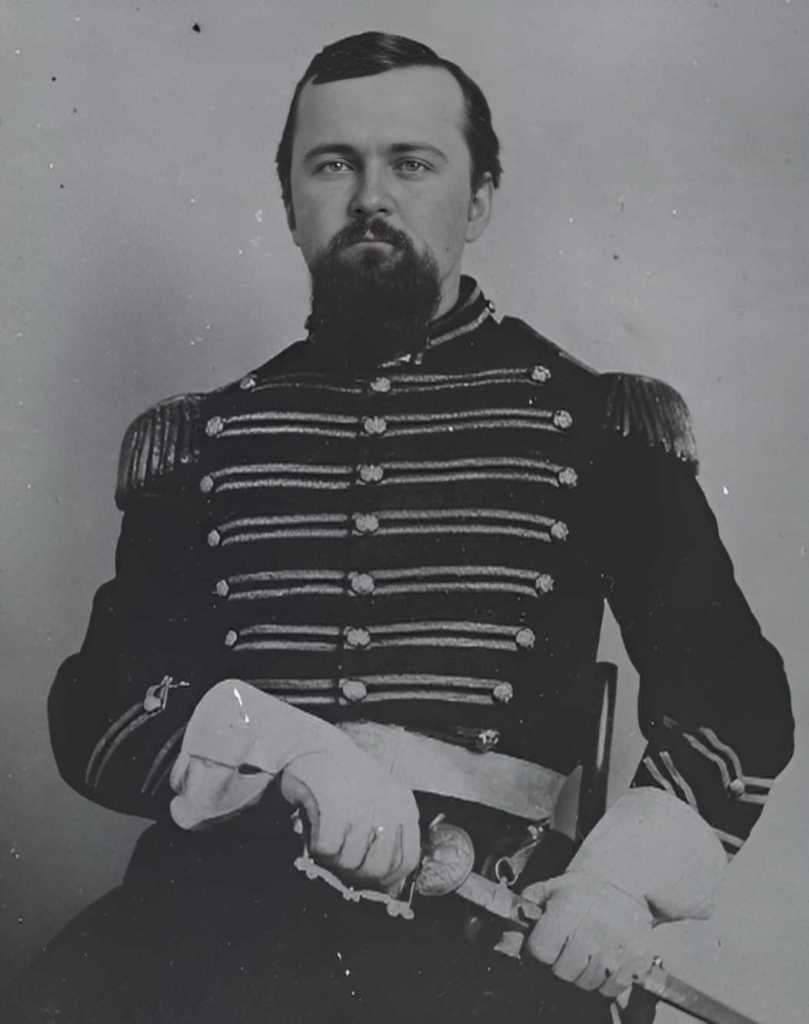
Many leaders, both past and present, come to mind as fitting this description—individuals who had the chance to do what was right but chose otherwise. In my family, my choice for the most infamous veteran is Col. William L. Saunders (1835–1891). Saunders served as a Colonel in the Confederate States Army (CSA) and was an educated attorney. Following the Civil War, he became the Secretary of State of North Carolina and led the Ku Klux Klan (KKK) in that state. His influence and actions, both during and after the war, are clear to me, even if they aren’t to others.

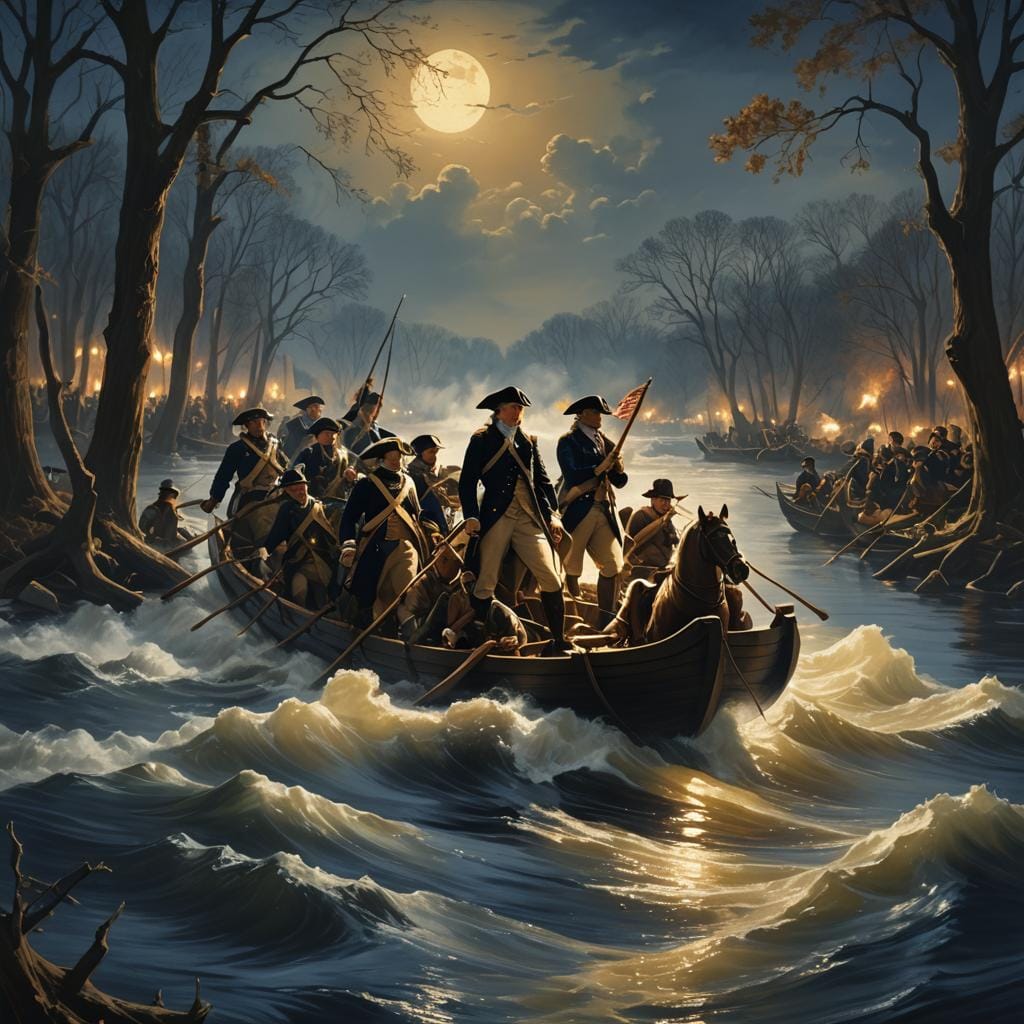
The Most Famous Veteran and Highest Ranking: Without a doubt, the most renowned veteran in my family tree is my 10th cousin, 7 times removed—General George Washington. Some might say, “Aha! An insurrectionist and slaveholder!” However, as I mentioned earlier, certain leadership qualities can spark a shift in thinking, and General Washington displayed some of these through his words and actions.
From a modern perspective, it may seem he could have done more, and sooner. Yet, he made a powerful statement by ultimately freeing his own slaves and sharing his changing views on the issue. This decision underscores a key aspect of leadership: the courage to model positive change, even within an imperfect system. That said, he was an insurrectionist—there’s no denying that. But to us, he was a hero.

This Veterans Day, I honor the veterans in my family tree who served with honor, courage, dedication, and sacrifice. From my earliest ancestor, John Thacher, who rose to the rank of Colonel in the colonial militia, to the youngest, Shubael Bumpus, who joined at just 17, each faced the unique challenges of their time. I am especially grateful for the service of those closest to me, like Uncle Mac and Uncle Claude in WWII, and for my Shervington cousins who came before me defending freedom in both world wars, paving the way with a legacy of service. Today, we remember their bravery and commitment, honoring the ideals of freedom and duty they upheld and passed down to us.
You can view the entire list of veterans in my family tree here. If you enjoyed this post, please consider hitting the like button. Thanks!
Do you have veterans in your family tree? Tell us about them in the comments below!
 Shervington.net